ESP: You’re raising two children on the autism spectrum while also sharing your home with your adult brother, who is also on the spectrum. How has that experience changed the way you define motherhood?
Emily: Wow, I’ve never really thought about that. I don’t know if it’s changed how I define motherhood, but it’s definitely led me to understand the definition more. I’ve always seen motherhood as this nurturing, selfless, and loving role. Then you have your own kids, and you really feel in your heart that they come first—to the point that it’s an instinct, really. As my kids have grown and I’ve seen their struggles, I think the role of nurturing and loving now incorporates a heavy emphasis on advocacy. It’s not only teaching them how to be kind people, but also how to be kind to themselves and to speak up when they need help.
ESP: What is something your children have taught you that you don’t think you would have learned any other way?
Emily: I have worked with special needs kids for a long time, and I’ve had families tell me I have a lot of patience. I always thought it never really felt like an active choice, but just a love for what I do. I reminded myself that these kids didn’t sign up for whatever diagnosis they have.
Once I became a parent of special needs kiddos myself, it really clicked. I understood why they said it. I was just working “it” 40 hours a week, and I knew it was harder for them since they had to live “it” 24/7. By “it,” I mean the constant worries, being proactive in anticipating needs, managing meltdowns, and finding help or therapies for this, that, and the other. Living “it” requires you to have patience not only for the kids, but also for yourself.


ESP: What’s one thing you wish people understood about families living with autism?
Emily: Autism is such a wide spectrum that people often make assumptions based on the extremes they’ve seen in movies or on social media. The truth is that every autistic person is completely different. Sensory needs, communication styles, interests, and support levels vary so much that no two families look alike.
What I wish people understood is that you don’t need to learn “everything about autism” to be supportive. What helps most is simply being curious about our child or our loved one. Ask why my daughter avoids loud noises, why my son needs to move constantly, or why my brother prefers certain routines. When we learn about each other as individuals, that’s how we build a more inclusive world.
ESP: What has been one of your biggest struggles—and what has helped you keep moving forward?
Emily: Probably self-care—and within that, asking for help. I see how many things need to be done to support my family, and I slip into this go-go-go mentality. I also hate the idea of “bothering” anyone because it feels like I’m adding to their plate when my whole goal is to make life easier for the people I love. It’s funny—we’d all tell our best friend to reach out and let us help, but we rarely give ourselves that same courtesy. My husband and mom often step in, and their love keeps me going.
ESP: What does inclusion look like to you?


Emily: I think Where the Pieces Meet is where I’ve felt most like my family is seen and valued. It’s the group I started for my brother a few years ago, but I never realized it would go beyond just neurodivergent adults finding friends. The families who come to the events make you feel understood and welcomed. Everyone there gets it. It’s a feeling I can’t fully describe or capture in words, but one that I hope all autism families get to experience at some point. It’s definitely everything I feel inclusion should be.
ESP: If another mom just received an autism diagnosis for her child today, what’s the very first thing you would want her to know?
Emily: I got chills from this question because I get these calls a lot from moms. I can hear the stress in their voices, and I say, “Before I give you any advice, phone numbers, or whatever, I just want you to know that you are doing a good job. The fact that you are calling people, took your baby for testing, and are making the effort to find things to help them… that makes you an amazing mom.”
Too many parents go to a place of self-blame, and that’s not fair. You didn’t sign up for this either, and you are doing whatever you can to make your child’s life better. That’s what makes a good mom to me.
Rapid Fire


Favorite dessert? Our Phiropoulos Family Secret Recipe for Chocolate Pie.
Messy bun or ball cap? Both!
Date night in or out? Out!
Text or phone call? Text.
One word your kids would use to describe you: Caring.
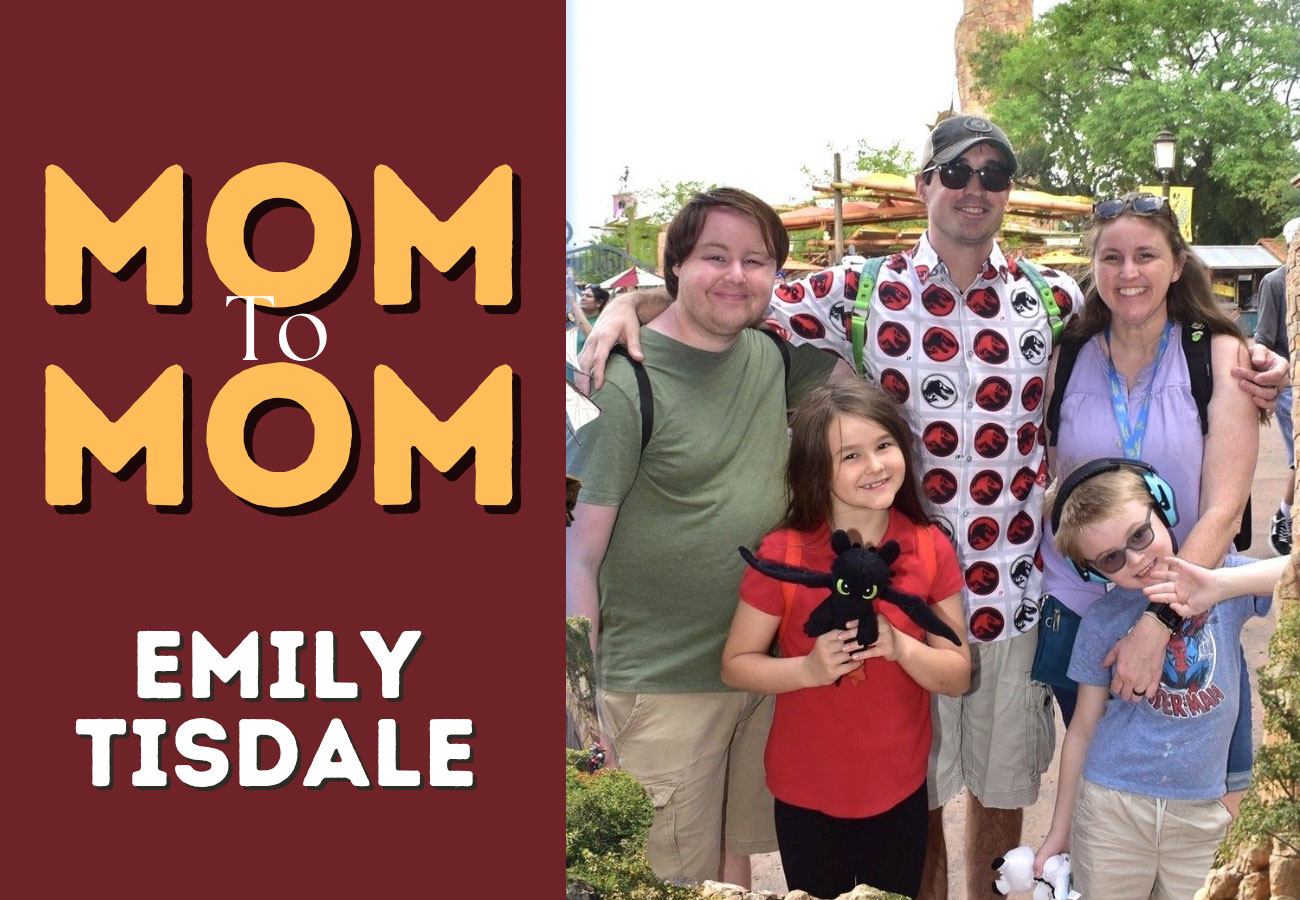
Emily Tisdale and her husband, Tim, are raising two incredible children, Ella (9) and Bond (6), while also caring for Emily’s younger brother, Zach. Their lives revolve around routines, school, Scouts, and making sure everyone has the downtime they need. Their home is filled with creativity, teamwork, and laughter. Emily says someone is always doing or saying something that turns into a funny story. The Tisdales have created a home where everyone is loved and accepted for exactly who they are.